What Can a Truck Driver Training Simulator Teach Before Road Practice?
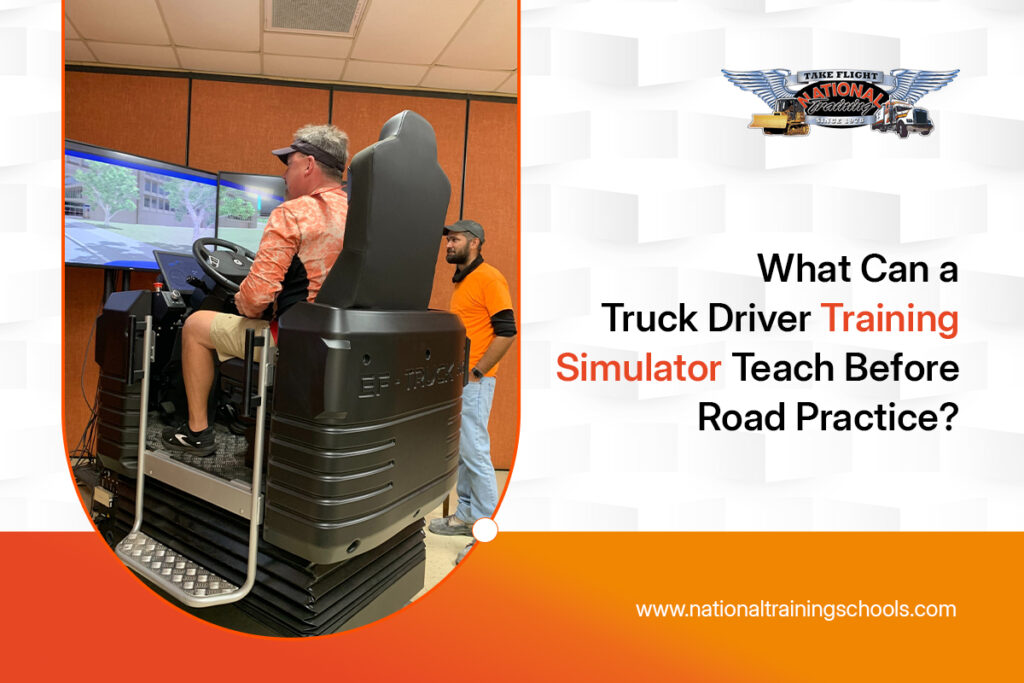
A truck driver training simulator can introduce students to selected driving concepts, controls, visual-search techniques, speed and space management, shifting, hazard perception, and backing concepts in a controlled environment. At National Training, Inc., simulator instruction supplements other forms of CDL training. It does not replace the behind-the-wheel training required under applicable Entry-Level Driver Training regulations.
What Can Students Learn From a Truck Driver Training Simulator?
A simulator gives students an opportunity to work with driving concepts before applying instruction in an actual commercial vehicle. National Training’s CDL simulator training uses realistic graphics, truck components, and a three-axis motion platform as part of its training environment.
Published National Training materials identify instructional areas including basic controls, visual search, speed management, space management, hazard perception, shifting and operating transmissions, and backing and docking. A truck driver training simulator can support this instruction by allowing students to become familiar with selected concepts and procedures in a controlled setting.
The purpose is not to establish that a student has mastered real-world commercial driving. Instead, simulation can introduce procedures and concepts before students apply applicable instruction in real equipment.
How Does Simulator Training Fit Before Road Practice?
Simulator instruction and actual vehicle instruction serve different purposes. This distinction is particularly important for students subject to federal Entry-Level Driver Training requirements.
The Federal Motor Carrier Safety Administration states that a driving simulator cannot substitute for mandatory ELDT behind-the-wheel training. A driver-trainee also cannot use a simulator to demonstrate proficiency for the behind-the-wheel curricula. FMCSA does, however, permit simulators to be used in theory training.
National Training similarly describes its simulator lab as a supplement alongside hands-on driving instruction at its training grounds.
Students comparing CDL training courses can therefore look beyond whether a school simply has a simulator. Ask how the technology fits into the broader training program and how simulator-supported learning connects with required behind-the-wheel instruction.
Considering CDL training? Review National Training’s current training program information and speak with admissions about how simulator instruction fits into the applicable training path.
What Should You Look for When Comparing Simulator-Supported Training?
A useful comparison should focus on the role of the simulator rather than the technology alone. Prospective students can ask which concepts are covered, how instruction is organized, how the simulator relates to the training program, and when students apply their learning in an actual commercial vehicle.
The distinction between theory, simulation, behind-the-wheel training, CDL testing, and licensing should also be clear. Completing one component should not be interpreted as automatically satisfying another.
National Training provides CDL education and training courses. Simulator participation by itself does not complete a CDL training program, produce a CDL, guarantee a passing test result, or guarantee employment.
Simulator Training as Part of the Larger Learning Process
The value of simulation is easier to understand when it is viewed as one instructional component rather than a replacement for driving a commercial vehicle.
For example, students may first become familiar with a control or driving concept in a controlled environment and later encounter the physical demands and vehicle response associated with real equipment. A truck driver training simulator can support this early learning, while actual vehicle training adds physical conditions and vehicle responses that simulation cannot fully reproduce.
Prospective students should therefore evaluate the entire training process. National Training makes school and training program information available through its school catalogs, which can help students review applicable policies and current training program information before making an enrollment decision.
Licensed by the Florida Commission for Independent Education, License No. 335.
Frequently Asked Questions
1. Can a truck driving simulator replace behind-the-wheel CDL training?
No. FMCSA states that simulators cannot substitute for mandatory ELDT behind-the-wheel training, and trainees cannot use simulation devices to demonstrate proficiency for behind-the-wheel curricula. Simulators may be used in theory training.
2. What can students practice with National Training’s CDL simulator?
National Training identifies areas including basic controls, visual search, speed and space management, hazard perception, shifting, and backing and docking among its simulator and computer-based training subjects.
3. Is simulator training the same as driving a commercial vehicle?
No. Simulation provides a controlled training environment. Actual commercial-vehicle instruction introduces real vehicle movement, handling, physical conditions, and other factors that simulation cannot fully reproduce.